Business
Raytheon Wins $745 Million MDA Contract for SM-3 IIA Interceptors
Raytheon, an RTX business, won a $745 million Missile Defense Agency contract for SM-3 IIA interceptor production and sustainment through 2031.
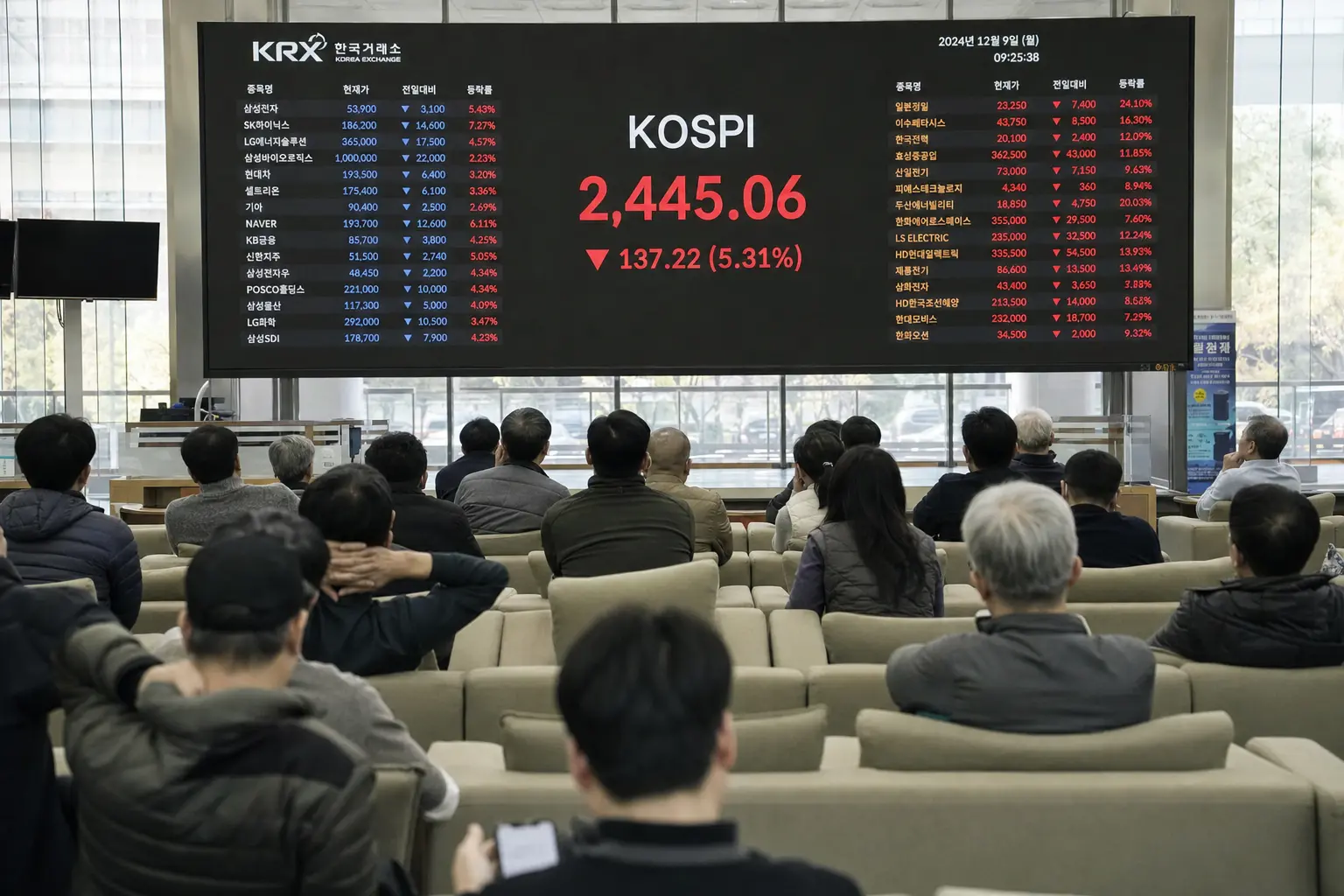
About 1.2 million leveraged retail accounts in South Korea were hit with margin calls on July 13 as the KOSPI collapsed nearly 9%, according to market-sourced trading data. Estimates circulating in the market put the number of fully liquidated accounts at roughly 320,000 to 360,000, with some investors left owing post-liquidation debts to brokers.
The KOSPI closed at 6,806.93, down 669.01 points, or 8.95%, after falling below 7,000 intraday. The index was down as much as 8.22% earlier in the session. A market-wide circuit breaker was triggered at about 1:28 p.m., halting trading for 20 minutes. Korean reports said it was the seventh such activation this year.
Foreign investors were net sellers of 2.2483 trillion won during the session, while institutions sold 572.7 billion won, according to SBS. The selling hit the market's semiconductor heavyweights hardest. Samsung Electronics fell 10.7% to 254,500 won, and SK Hynix dropped 15.37% to 1,845,000 won.
Retail leverage had become concentrated in chip names and in leveraged products tied to AI and memory shares. When collateral values fell, margin calls turned into mechanical selling that added to the decline in the underlying stocks and the index.
The account figures have been reported by market intelligence and trading-desk sources and echoed in Korean media summaries. They have not been formally confirmed by the Korea Exchange, the Korea Financial Investment Association, or financial regulators. The scale aligns with the severity of the selloff and with weeks of mounting stress in Korea's margin market.
That stress had built through June and early July. Korean media, citing industry data, reported 425.8 billion won of forced liquidations tied to unsettled trades from July 1 to July 10, including 142.2 billion won on July 9 alone. In late June, forced sell-offs exceeded 40 billion won per day for four straight sessions, and cumulative forced sales between June 22 and June 26 reached 271.7 billion won.
The backdrop was record retail leverage. Data cited by Bloomberg, Reuters, and local outlets put outstanding margin loans or leveraged equity exposure at roughly 38 trillion won to 39 trillion won by late spring or early summer. The Bank of Korea had flagged growing risks tied to debt-funded equity speculation, and some brokerages reportedly tightened margin lending rules as the KOSPI rallied.
The investor concern now extends beyond equity losses. Reports from market-data providers and Korean media say some accounts ended with negative balances after broker liquidations, meaning sale proceeds were insufficient to repay borrowed funds. That creates a direct credit issue for brokerages and a balance-sheet problem for affected households.
It also raises the prospect of tighter lending terms, stronger risk controls, and closer regulatory scrutiny of retail margin practices. In a market with high leverage and heavy concentration in a few technology stocks, sharp index moves can quickly become forced deleveraging.
Get trusted financial analysis, breaking market news, and expert commentary delivered directly to your inbox every morning.